
Care library › Senegal Parrot
Care guide
Senegal Parrot
Poicephalus senegalus
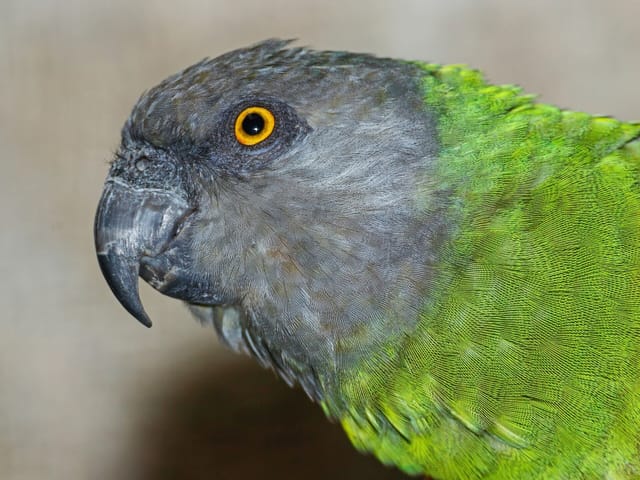
A compact West African parrot with a grey head, green back and a bright orange-yellow vest. Senegals are quieter than most parrots, which makes them one of the few that work in an apartment, and they bond hard, which makes them the parrot most likely to decide that one person is the flock and everyone else is an intruder. Socialised early and widely, they are affectionate, playful, acrobatic companions for thirty years.
- Size9 inches
- Lifespan25–30+ years
- Weight120–170 g
- HousingBonds closely; socialise widely
- LevelIntermediate
1. Natural History
- Range: Open woodland and savanna across West Africa from Senegal to Nigeria, in small flocks of ten to twenty.
- Build: Stocky and short-tailed, with a large head and a heavy beak for a bird this size. They are strong fliers and surprisingly good climbers.
- The Poicephalus family: Meyer's, red-bellied, brown-headed and Jardine's parrots are close relatives, and nearly everything here applies to them too.
2. Temperament
- Quiet, mostly: Senegals chirp, whistle and talk a little; they rarely scream. This is the main reason people choose them, and it holds true as long as the bird is not bored.
- One-person birds: Left to their own devices they pick a person and defend that person from the rest of the household with a nip that draws blood. The fix is prevention: from day one, every member of the household feeds, handles and trains the bird, and the favourite person steps back when the bird gets possessive.
- Fear and flooding: Senegals are prone to phobic reactions to new objects, hands from above, and sudden changes. Introduce new toys outside the cage first, approach from the front and below, and go slowly.
- Play: They love hanging upside down, swinging and wrestling with toys. A Senegal on its back in your hand is a happy bird, not a sick one.
3. Housing
- Cage: 24 × 24 × 24 inches minimum, 30 × 30 better, with bar spacing of 5/8 to 3/4 inch. A cage built for a cockatiel is too small and a cage built for a macaw has bars they can get their head through.
- Perches and toys: Natural branches of several diameters, a rope perch, a swing, and a rotation of small shreddable and foraging toys. Senegals are strong chewers for their size.
- Placement and sleep: In the room where people spend their time, against a wall, with 10–12 hours of covered, dark sleep. An overtired Senegal is a nippy Senegal.
4. Diet
- Pellets: The base of the diet, around 60–70%, in a size made for small parrots.
- Fresh food daily: Dark leafy greens, peppers, carrot, broccoli, squash, peas, green beans, a little fruit. Many Senegals are suspicious of new foods; keep offering, and eat the food in front of them.
- Watch the waistline: Poicephalus parrots get fat easily. Seed and nuts are training treats only, a sunflower seed or a sliver of almond at a time.
- Never: Avocado, chocolate, caffeine, alcohol, onion, garlic, xylitol, fruit pits.
5. Daily Life & Enrichment
- Out-of-cage time: Two to three hours a day, on a playstand near you or on you. A Senegal that only sees the inside of a cage becomes a biter.
- Foraging: Make them work for pellets: paper-wrapped parcels, small foraging wheels, pellets pushed into a cardboard tube.
- Training: Step-up, target and a reliable recall. Because of the one-person tendency, every household member should run a short training session each week.
- Bathing: Mist or a shallow dish two or three times a week.
6. Household Hazards
- PTFE (Teflon) fumes from overheated non-stick cookware and appliances kill small parrots fastest of all. No non-stick in a bird household.
- Air and physical hazards: Scented products, smoke and vape, aerosols, ceiling fans, open water, hot surfaces, windows, other pets, and any toy with gaps a head or toe can be trapped in.
7. Health
- Avian vet yearly, with a baseline blood panel. Quarantine any new bird 30–45 days away from existing birds.
- Signs of illness: Fluffed and quiet, tail bobbing, sitting low, change in droppings, sneezing or discharge, weight loss. Small birds crash fast; call the same day.
- Common problems: Obesity and fatty liver, vitamin A deficiency from seed diets, aspergillosis, psittacosis (contagious to people), feather plucking from boredom or a possessive bond, and injuries from a nipped partner bird. Senegals should not be housed with other species.
- Weigh weekly on a gram scale.
8. Essential Supplies Checklist
- Cage at least 24 × 24 × 24 in with 5/8–3/4 in bar spacing
- Three or four natural-wood perches, a rope perch and a swing
- Playstand for time out of the cage
- Small-parrot pellets, fresh chop, stainless bowls
- Foraging and shreddable toys in rotation
- Gram scale, travel carrier, cage cover, and the avian vet's number
Header photo: H. Zell, CC BY-SA 3.0, via Wikimedia Commons.
Health questions? The Parrots section of our health FAQ covers the problems we are asked about most. It is general hobby knowledge, not veterinary advice.
Important. These guides reflect the husbandry we use at Chaos Creatures and the published research we trust. They are not a substitute for a reptile veterinarian. If an animal is lethargic, refusing food for an extended period, has a wound or is breathing with its mouth open, see a vet.
Last reviewed Nov 11, 2026. Questions about this guide? Ask the rescue. Something wrong with the animal? Find an exotic vet near you.