Care library › Bearded Dragon
Care guide
Bearded Dragon
Pogona vitticeps
Diurnal, sun-loving lizard from the dry interior of Australia. Calm, curious and tolerant of handling, which is why it is the most popular pet lizard in the world. The catch is equipment: a bearded dragon needs real UVB and a hot basking spot every single day, and most problems we see at the rescue trace back to one of those two things.
- Size16–24 inches
- Lifespan10–15 years
- Weight300–550 g adult
- HousingSolitary only
- LevelBeginner, with the right kit
1. Natural History
- Range: Arid and semi-arid woodland, scrub and desert across inland eastern Australia. Export from Australia has been banned since the 1960s, so every pet dragon is captive-bred, most lines many generations deep.
- Lifestyle: Diurnal baskers. They spend mornings warming on rocks and branches under full sun, then forage. Captive husbandry copies that: a very hot basking spot, strong UVB, and a cooler retreat.
- The beard: The spiky throat pouch darkens and puffs when the dragon is stressed, displaying or cold. Black-bearding alone is not an emergency, but a dragon that is black-bearded for hours needs its temperatures checked.
- Arm waving and head bobbing: Waving is submission or acknowledgement, bobbing is dominance or courtship. Both are normal. Two dragons doing it at each other in one enclosure is the reason they must be housed alone.
2. Enclosure
- Adult minimum: 4 ft × 2 ft × 2 ft (120 gallons). A 40-gallon breeder is a starter tank, not a home. Bigger is better; they use every inch of floor space and will climb.
- Babies: Can go straight into the adult enclosure as long as food is easy to find and there are several hides. A huge tank does not stress a hatchling; cold spots and poor UVB do.
- Type: Front-opening PVC or wood enclosures hold heat and humidity better than glass. Screen tops bleed heat and block a large share of UVB. If you use a glass tank with a screen lid, mount the UVB inside.
- Furniture: One basking platform (slate, a thick branch or a flat rock) directly under the heat and UVB, a hide on each side, a shallow water dish, and some climbing branches. Rough surfaces help nails stay short.
- Substrate: Paper towel or slate tile for babies, sick animals and quarantine. For healthy adults a sand-and-soil mix that holds a dig (roughly 60/40 play sand to organic topsoil, no fertiliser) or a bioactive setup is natural and lets them dig. Calcium sand, walnut shell and reptile carpet are not: the first two can clog the gut, carpet snags toes and holds bacteria.
3. Heat & Light
- Basking surface: 100–110°F for adults, 105–110°F for babies, measured with an infrared temp gun on the surface itself, not the air. Use a halogen flood or a deep-heat projector on a dimming thermostat. Heat rocks and heat mats are useless to a basking lizard and can burn.
- Cool side: 75–85°F. Night-time can drop to 65–75°F with everything off. Only add a night heat source if the room goes below 65°F, and make it a non-light source (deep-heat projector or ceramic) on a thermostat.
- UVB is not optional: A linear T5 HO tube rated 10–12% (Arcadia 12% or Zoo Med ReptiSun 10.0 T5 HO) spanning at least half the enclosure, positioned so the basking spot sits 12–15 inches below it with no glass or plastic in between. Coil bulbs and "full spectrum" LEDs do not do this job.
- Replace on schedule: UVB output fades long before the tube stops glowing. Replace T5 tubes every 12 months, T8 every 6, and write the date on the fixture.
- Day length: 12–14 hours of light in summer, 10–12 in winter, on a timer. Everything off at night. Blue, red and "moonlight" bulbs disturb sleep.
4. Diet
- Babies and juveniles (under 12 months): About 70–80% insects, offered two or three times a day for as many as they will eat in 10–15 minutes, plus fresh greens every day whether they touch them or not. The greens habit is built now.
- Adults: Flip it. 70–80% greens and vegetables daily, insects two or three times a week. An adult fed insects daily becomes obese and develops fatty liver disease.
- Staple greens: Collard, mustard and turnip greens, dandelion, endive, escarole, squash (butternut, acorn), bell pepper, green beans. Occasional: kale, bok choy, carrot, berries, melon. Avoid as a staple: spinach, chard and beet greens (bind calcium), iceberg and romaine (no nutrition), avocado and rhubarb (toxic).
- Staple insects: Dubia roaches, black soldier fly larvae, crickets, silkworms, hornworms as a treat. Mealworms and superworms are fine for adults in moderation. Never wild-caught insects, never fireflies (fatal), and size no insect longer than the space between the dragon's eyes for babies.
- Supplements: Dust insects with plain calcium (no D3) at most feedings if your UVB is good, a calcium with D3 once or twice a week, and a reptile multivitamin once a week. Over-supplementing D3 with strong UVB can cause problems; under-supplementing causes metabolic bone disease. When in doubt, more UVB and plain calcium.
- Water: Many dragons do not drink from a still dish. Offer a shallow dish anyway, mist the greens, and give a warm shallow bath once a week or so. A dragon that has stopped eating greens is often dehydrated first.
5. Handling
- Support the whole body: Scoop from underneath with the tail along your forearm. Never pick up by the tail, and never let the legs dangle.
- New arrivals: Give them a week to settle before regular handling. Short, calm sessions several times a week build trust faster than one long one.
- Wash your hands before and after. Reptiles can carry salmonella without being ill.
6. Health & Common Problems
- Metabolic bone disease: The big one. Caused by too little UVB and calcium. Signs are a rubbery jaw, twitching toes, swollen limbs, tremors and a dragon that lies flat and cannot lift its body. Early cases recover with corrected husbandry and vet-prescribed calcium; late cases do not.
- Impaction: Loose particle substrate plus cold temperatures plus oversized or hard-shelled food. Signs are straining, no droppings for a week or more, a hard belly and dragging back legs. Warm baths and a vet, not oil down the throat.
- Parasites: Pinworms and coccidia are common, especially in animals from pet shops. A faecal test at the first vet visit and yearly after is cheap insurance.
- Yellow fungus (CANV): Yellow or brown crusty patches that spread and do not shed off. Contagious to other reptiles and needs a vet quickly.
- Tail rot, mouth rot, respiratory infection: A darkening tail tip that does not shed, pus or swelling around the mouth, or open-mouth breathing with mucus. All are vet visits.
- Brumation: Many adults slow down and sleep for weeks in winter, eating little. It is normal in a healthy adult with a stable or rising weight. Weigh weekly; a dragon that loses more than about 10% or is under a year old should be checked, not left to it.
7. Sexing
- Wait until roughly 6 months. Hold the dragon gently and lift the tail toward the back at a shallow angle, then look at the base of the tail just past the vent.
- Males: Two bulges with a dip between them (hemipenes), larger femoral pores on the underside of the thighs, and usually a broader head.
- Females: One central bulge or a smooth tail base and small pores.
8. Essential Supplies Checklist
- 4 × 2 × 2 ft enclosure, front-opening if possible
- Halogen flood or deep-heat projector plus a dimming thermostat
- Linear T5 HO UVB tube (10–12%) with a reflector, replaced yearly
- Infrared temp gun and a digital thermometer/hygrometer
- Basking platform, two hides, climbing branches, shallow water dish
- Plain calcium, calcium with D3, multivitamin
- Feeding tongs, an insect-keeper tub, and a kitchen scale for weekly weights
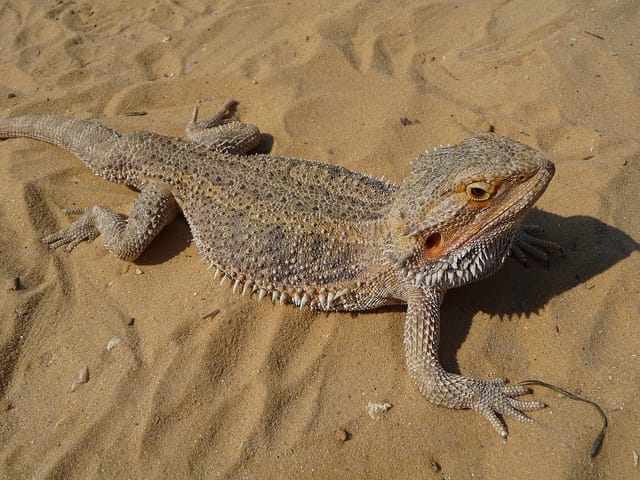
Header photo: public domain, via Wikimedia Commons.
Health questions? The Bearded dragons section of our health FAQ covers the problems we are asked about most. It is general hobby knowledge, not veterinary advice.
Important. These guides reflect the husbandry we use at Chaos Creatures and the published research we trust. They are not a substitute for a reptile veterinarian. If an animal is lethargic, refusing food for an extended period, has a wound or is breathing with its mouth open, see a vet.
Last reviewed Nov 11, 2026. Questions about this guide? Ask the rescue. Something wrong with the animal? Find an exotic vet near you.