
Care library › Ball Python
Care guide
Ball Python
Python regius
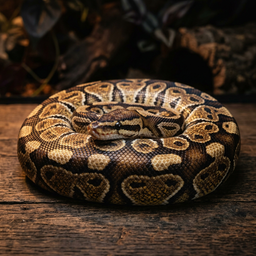
Ball pythons (also known as royal pythons) are a terrestrial species of constricting snake native to regions of western and central Africa. In the wild, they are most often found in semi-arid grasslands, forests, and near agricultural areas. Although frequently found in burrows, they can arguably be considered semi-arboreal, as scientific accounts have documented them hunting frequently in trees. They are very popular in the pet trade and are often sold as beginner pets due to their docile temperaments and manageable size. Although ball python care isn’t necessarily “easy”, their hardiness still makes them a good fit for new reptile keepers.
- Size♂ 3.6–4.3 ft / ♀ 3.8–4.5 ft
- Lifespan15–30+ years
- Weight1,000–2,500g
- HousingSolitary only
- LevelIntermediate
1. Natural History & Unique Physical Traits
- Natural Habitat: Native to the savannas, grasslands, and open forests of West and Central Africa. They spend their days sheltering underground in rodent burrows or termite mounds.
- Hunting & Activity: These snakes are crepuscular, which means that they are most active at night, but especially active around dawn and dusk. As ambush hunters, they actively track down and then wait for prey such as rodents, birds, and lizards to scurry past before striking, using powerful constricting muscles to squeeze the prey until it passes out (which is humane and occurs within seconds, according to a 2015 study by Boback et al.).
- Size & Dimorphism: Ball pythons are sexually dimorphic, which means there is a noteworthy difference in size between males and females, but not as large as in some other snake species. According to an extensive survey by Aubret et al., males typically grow 3.6–4.3 ft (109–131 cm) long, while females grow to be 3.8–4.5 ft (114–136 cm) long. However, larger individuals have been recorded in captivity, likely due to more plentiful food.
- Defense Mechanism: Known as "Ball Pythons" because they curl into a tight ball when stressed or threatened, tucking their head and neck safely inside their coils.
- Heat-Sensing Pits: Possess visible thermal pits along their upper lip. These pits detect infrared radiation, allowing them to sense warm-blooded prey in absolute darkness.
- Lifespan & Maturity: Reach sexual maturity in 3–5 years and have a 15–30 year lifespan in captivity. However, much older individuals have been reported (with some exceeding 40 years).
- Genetic Diversity & Morphs: This species is well known for its incredible genetic diversity; part of their current popularity is due to a fad for producing “morphs” (variations in color and pattern). Many experienced hobbyists take on ball python breeding as a study in snake genetics. Because of this trend, the market is currently saturated with snakes who didn’t make the cut for the next generation, and so breeding should be attempted with extreme caution.
- Habitat Adaptability: Unlike many other reptile species, ball pythons are highly adaptable, and have been significantly less affected by human encroachment on their natural habitat than others. Although they generally prefer a forested habitat, they have adapted very well to farmland by taking over existing animal burrows.
2. Choosing the Perfect Enclosure
- The Enclosure Size Myth: There is a common misconception about ball pythons that large enclosures stress them out, and they prefer to be crammed in tiny, dark plastic boxes or undersized terrariums where they barely have enough room to move or even stretch out. THIS IS A MYTH — and this approach to ball python care often leads to severely overweight snakes with poor muscle tone and no sources of mental stimulation or enrichment.
- Enclosure Size Guidelines: Keeping adult ball pythons in undersized enclosures is not the “best” way you can care for them — it’s actually a violation of basic animal welfare. Here are the minimum dimensions for your pet ball python enclosure, based on snake size. All dimensions are given in Length x Width x Height:
| Life Stage | Weight/Size Range | Minimum Dimensions | Approximate Volume |
|---|---|---|---|
| Hatchling | Up to 300g | 20″ x 11″ x 13″ (50 x 28 x 33cm) | 10 Gallons (or tub equivalent) |
| Juvenile | Under 3′ long | 36″ x 18″ x 18″ (90 x 45 x 45cm) | 40 Gallons (or tub equivalent) |
| Sub-Adult / Adult | Over 3′ long | 48″ x 24″ x 24″ (120 x 60 x 60cm) | 120 Gallons (Minimum) |
- The Length-Matching Rule: In other words, ball pythons (and snakes in general) should be housed in an enclosure which is at least as long as they are. This provides sufficient space to allow them to stretch out to their full length instead of being cramped and semi-coiled all the time. This means that a 5′ ball python should be housed in a 5′ long enclosure, a 6′ ball python should be housed in a 6′ long enclosure, etc. Providing additional height to accommodate natural climbing behavior is best practice. If you choose alternative dimensions, make sure there’s about 8 sq ft (0.74m²) of floor area and at least 2′ of vertical space for climbing — preferably more, especially for males.
- Types of Ball Python Enclosures:
• Glass: Contrary to popular belief, glass enclosures (aka aquariums) are not evil. They do tend to be expensive, heavy, not very durable, and can present some trouble with maintaining consistent temperatures and humidity. But it’s because of that latter quality, glass is one of the best materials at dissipating heat, and that it makes creating a temperature gradient much easier. It also helps encourage a natural cycle of drying in the enclosure, which discourages mold growth in a humid environment that could otherwise go out of control very easily. When done right, glass enclosures are very attractive and easy to clean. For best results, cover 3 of the enclosure’s 4 walls with an opaque material like construction paper to help your ball python feel optimally secure in his/her environment. Chaos Creatures recommends glass enclosures from brands like Repti Zoo.
• PVC/HDPE: These enclosures can also be quite attractive, easy to clean, hold humidity well, are lightweight, and are more durable than their glass counterparts. They’re also opaque on all sides but the front, and of course front-opening. The best PVC enclosures have a mesh top for easier and safer lamp fixture placement as well as improved ventilation. Chaos Creatures recommends PVC enclosures from brands like Zen Habitats (4’x2’x2′ or 4’x2’x4′), Dubia.com (4x2x2 / 120 Gallon), Kages (recommended with "2 square screens" customization), and Toad Ranch Luxury Reptile Habitats (“The Royal Lounge” 4’x2’x4′ or 6’x3’x3′). - Lid Security (Lock it Down): It’s best to choose a front-opening enclosure, as it makes accessing the snake much easier (and less startling for the snake). Front-opening enclosures are also more secure and more difficult for a snake to escape from. If for some reason you must use a glass enclosure with a screen top, be sure to get lid locks; like many snakes, ball pythons can be expert escape artists, and it can be very difficult to find a small snake hiding in your house. DO NOT SECURE YOUR LID WITH TAPE! Many snakes have been severely injured through accidental contact with the sticky side of tape.
- Terrarium Cleaning Frequency:
• Daily / Spot-clean: The enclosure should be spot-cleaned (removal of visible waste) every time your snake defecates. This also involves the removal and replacement of contaminated substrate, as well as the cleaning of any visibly dirty décor.
• Every 3-4 months: Completely replace the substrate.
• Every 6 months: The enclosure and all accessories should be deep-cleaned and sanitized with Rescue, F10SC, or a 10% bleach solution.
3. Heating, Lighting, & Climate Control
- Day Length: Because ball pythons are crepuscular, additional light beyond what illuminates the reptile room is not widely considered “necessary.” However, it is best practice to keep a light on to mimic nature’s day/night cycle. Because of their equatorial origin, Chaos Creatures recommends a day/night cycle of 12 hours on, 12 hours off. If you want to get more specific with your light cycle, you can leave the lights on for 12.5 hours during summer and 11.75 hours during winter.
- UVB Provision: The best way to provide low-level illumination for your ball python is with a low-strength UVB fluorescent as your light source. It is commonly believed that nocturnal snakes do not “need” UVB, therefore it would be a waste of money to provide it. While this reasoning may seem sound, it oversimplifies the issue. UVB does more for a reptile than help them synthesize vitamin D3; for example, ball pythons can see ultraviolet light. Recent studies indicate that UVB can be beneficial for snakes’ long-term physical and mental health. To provide UVB for ball pythons in a 4x2x2 enclosure, use a 22″ long, low-intensity T5 HO fluorescent tube (not coil). We recommend sticking with the Zoo Med or Arcadia brand.
- Basking Target (UVI 2.0-3.0) Distance: To achieve a UVI of 2.0-3.0 in the basking area (closest location to the UVB lamp), you will need a specific distance between the UVB bulb and the snake’s back when basking (assuming a ~35% mesh block):
| Setup Configuration | Arcadia ShadeDweller MAX | Zoo Med T5 HO 5.0 / Arcadia 6% |
|---|---|---|
| Mounted Above Mesh | 4″ – 6″ (10 – 15cm) | 10″ – 14″ (25 – 35cm) |
| Without Mesh Obstruction | 6″ – 8″ (15 – 20cm) | 14″ – 18″ (35 – 45cm) |
- UVB Bulbs & Fixtures: It is strongly recommended to use a Solarmeter 6.5 to determine the best placement. If you need more distance between your snake and the UVB than your enclosure’s setup allows, use a UVB riser/prop to strategically increase the distance. Mount your UVB bulb in a Vivarium Electronics T5 HO or Arcadia ProT5 fixture. Plan on changing your UVB bulb every 12 months. Make sure that the fixture doesn’t have a piece of glass or plastic to “protect” the bulb, as UVB rays are blocked by glass and plastic. Naked UVB bulbs are effective UVB bulbs!
- Temperature Gradients: Because ball pythons are reptiles, they are cold-blooded, and that means they rely on their environment for the heat needed to regulate their metabolism. If the temperatures or humidity is off, the snake may stop eating. Provide the following gradients:
| Area | Ideal Temperature |
|---|---|
| Basking Surface (Hot Spot) | 95°F – 104°F (35°C – 40°C) |
| Warm Hide Ambient | 86°F – 90°F (30°C – 32°C) |
| Cool Hide Ambient | 72°F – 80°F (22°C – 27°C) |
| Nighttime Temperature | 70°F – 78°F (21°C – 26°C) |
- Climate Notes: General air temperatures in a ball python’s enclosure should never exceed 95°F (35°C)! If your home gets cooler than 70°F (21°C) at night, you will need a lightless heat source to warm up the air. Options for nighttime heat include ceramic heat emitters (CHEs), radiant heat panels (RHPs), and deep heat projectors (DHPs). CHEs, RHPs, and DHPs produce weaker spectrums of infrared radiation (heat) and should not be used as a primary daytime "basking" heat source.
- Measuring Temperature: Use an industrial-grade temp gun (infrared thermometer like the Etekcity 774) for point-and-shoot accuracy all over the enclosure, including inside hides. For continuous temperature monitoring, use at least two digital probe thermometers, with the probes placed on both the warm and cool sides.
- Daytime Heating Methods: The most important part of the enclosure to pay attention to for heat is the **warm hide** (located on the warm side directly underneath the basking lamps). The best way to simultaneously create a basking spot and warm hide is with a cluster of heat lamps. Heat lamps warm both the ground and air inside of an enclosure, which is the most natural way to heat terrariums. Incandescent/halogen heating provides Infrared-A radiation, which penetrates deeply into tissues, helping snakes stay warm longer and strengthening their immune system. Be sure to buy white or clear bulbs rather than red, blue, or black.
• Best: **Infatile/Reptile Systems Infrared Heat Units** (superior IR-A output, long-lasting, wide beam).
• Good: **Halogen or Incandescent Bulbs** like Reptile Systems Eco Halogen, Arcadia GoldenSun Halogen, Vinaco Halogen Flood bulbs, Exo Terra Intense Basking Spot, or Repti Zoo Intense Basking Spot. If the enclosure is more than 36″ long, use a cluster of at least two bulbs to create a large basking area to heat the entire body.
• Mounting: If using screen-top, mount dome lamp fixtures over the mesh (Zoo Med Combo Deep Dome). If installing inside, you **MUST** install protective bulb cages like the Arcadia Heat Lamp Cage to prevent severe burns!
• Thermostat Control: All heat lamps should be regulated. Fluctuations should be managed using a proportional (dimming) thermostat like the Herpstat 1. Non-proportional thermostats turn lights on/off, which is highly disruptive. - Belly Heat & Basking Surface: Place a thin, flat, dark rock (flagstone or slate) directly under the heat lamp. This creates a natural basking surface and transfers heat down to the warm hide placed beneath it.
- Secondary Heat Source (Heat Mat): Heat mats should only be used as a secondary heat source to maintain warm hide temperatures. NEVER use a heat mat as a primary heat source; they cannot warm the ambient air through a deep substrate layer and present a severe burn hazard. Rules for heat mat safety:
1. Connect the mat to a good thermostat (Inkbird or Herpstat 1). Heat pads without thermostats are a severe fire and burn hazard.
2. Bury the mat 1″ below substrate under the warm hide, or place it on top of a black plastic box hide with flagstone on top.
3. Place the thermostat probe at the snake's level (inside the warm hide resting on substrate) so you control the exact temperature they experience. Check probe position daily. - Radiant Heat Panel (RHP) (Okay): RHPs excel at creating large areas of warmth in larger enclosures and have a lower burn/fire risk. They must be regulated by a dimming thermostat.
- DO NOT USE HEAT ROCKS! Heat rocks are extremely dangerous, fail frequently, and cause severe, deep tissue burns. They do not heat the air.
- Humidity Control: Maintain baseline ambient humidity at 60% – 80% (rising to 80% – 100% at night). Use a digital hygrometer with the probe placed in the middle of the enclosure to monitor average levels. Tips to maintain humidity:
1. Use at least 4″ of moisture-retentive substrate (deeper substrate holds more moisture).
2. Pour water directly into the corners of the substrate to wet the lower layers without leaving the top surface damp (which causes scale rot).
3. Use a pressure sprayer (like the Exo Terra Pressure Sprayer) to mist every evening/morning, or install an automatic mister.
4. Provide a **humid hide** (lined with wet sphagnum moss) on the cool/middle end. Replace moss frequently.
5. Convert to a bioactive vivarium using soil, leaf litter, and live plants (such as the Bio Dude Terra Firma bioactive kit).
4. Safe & Unsafe Bedding (Substrate)
- Good Substrates:
• Sphagnum Moss: Inexpensive, holds moisture well, great for burrowing.
• Reptichip / Babychip: Coconut husk chips. Absorbs odors and moisture exceptionally well.
• DIY Tropical Mix: 40% organic topsoil, 40% coconut fiber, 20% play sand. Cheap and holds humidity without molding.
• The Bio Dude Terra Firma: Bioactive-ready natural substrate that retains humidity and nourishes live plants. Lasts a long time. Must be used with live plants. - Okay Substrates:
• Zoo Med Eco Earth: Coconut fiber. Holds humidity well but can get stuck in a ball python's heat pits when dry.
• Zoo Med ReptiSoil: Specially made soil. Drains well but can get muddy. Best mixed with topsoil and sand.
• Zoo Med Forest Floor: Pure cypress mulch. Attractive and holds humidity well. If using commercial mulch, sanitize by baking in the oven on a baking sheet at 250°F (121°C) for an hour to kill pests/mites.
• Blue Shop Towels: Excellent, clean option for quarantine and hatchlings. Easy to monitor waste. - Bad Substrates (Never Use):
• Reptile Carpet: Cannot handle big messes, harbors bacteria, and rips out claws or teeth.
• Carefresh / Paper Bedding: Too dusty and cannot hold humidity.
• Aspen Shavings: Molds rapidly under high humidity.
• Pine / Cedar Shavings: Aromatic oils (phenols) cause neurological and respiratory damage.
5. Feeding, Vitamins, & Proper Hydration
- Prey Sizing Rule: Feed size-appropriate rodents that weigh approximately 10% – 15% of your ball python's body weight (e.g., if the snake weighs 400g, feed a rodent weighing 40g – 60g).
- Feeding Schedule & Sizing:
| Life Stage / Weight | Feeding Interval | Prey Weight (% of Body Wt) |
|---|---|---|
| Hatchling / Juvenile (Up to 200g) | Every 5 – 7 Days | 10% – 15% (Mice/Small Rats) |
| Sub-Adult (200g – 1000g) | Every 7 – 10 Days | 10% (Medium Rats) |
| Adult (1000g+) | Every 10 – 14 Days | 5% – 7% (Large Rats) |
- Sourcing Feeders: Avoid buying prey from large chain pet stores due to salmonella risks and low nutritional quality. Buy from independent local pet shops, reptile expos, or in bulk online (Perfect Prey or Layne Labs).
- Dietary Variety: Offering a variety of prey is best practice for complete nutrition. Rotate rats, mice, African soft-furred rats (ASFs), gerbils, hamsters, young guinea pigs, young rabbits, chicks, and quail chicks. Birds are a natural part of their diet (especially for arboreal-hunting males). **Reptilinks** can be used, though some snakes may refuse them due to lack of fur/feathers.
- Preparing Frozen-Thawed (F/T) Prey: Thaw prey in the refrigerator overnight to discourage bacterial growth. 15-30 minutes before feeding, place the prey in a plastic Ziploc bag and submerge in hot water until the body temperature reaches approximately 98°F – 100°F (37°C – 38°C). Verify temperature with your temp gun.
- Live Feeding Rules: F/T is highly recommended. If you must feed live, never leave the rodent unsupervised with the snake. Remove the feeder if not eaten in 15–30 minutes. NEVER stun live feeders; if they wake up, they may enter defensive mode and severely injure or kill your snake.
- Supplements: Dust prey items with a calcium + multivitamin supplement (such as Repashy Calcium Plus LoD or Arcadia RevitaliseD3) once or twice a month. Replace supplements every 6 months due to vitamin decay. Use calcium with D3 if you do not use UVB.
- Feeding Location: Always feed **inside** the enclosure. Removing the snake to feed causes severe stress and lead to food refusal or regurgitation. "Cage aggression" is a myth; touch-train instead.
- Skipping Meals (The Wall): Adult ball pythons commonly go off feed or "fast" during winter or breeding season. Young adult females around 1000g are notorious for this ("the Wall"). As long as the snake looks healthy and doesn't lose more than 10% of its body weight, do not panic or attempt to force-feed. Track weight weekly using a kitchen scale.
- Obesity Warning: A healthy ball python should look like a melted Hershey's Kiss in cross-section (rounded sides with a gentle peak at the spine). An invisible spine means the snake is obese; a prominent spine means it is underweight. Obesity is a major health issue for captive snakes.
- Erratic Feeding: Randomizing prey types, sizes, times of day, and presentation (tongs, hidden in cage) replicates wild hunting, encourages activity, and stimulates a stronger feeding response.
- Water Source Warning: Provide a large, heavy ceramic bowl of fresh water daily (big enough to soak in). **DO NOT use distilled or softened water**; the lack of minerals creates an osmotic imbalance in the snake's body, stripping their system of minerals and causing chronic dehydration. Use clean, hard tap water.
6. Safe Handling & Deciphering Behavior
- Acclimation: Allow 2 weeks of zero handling after arrival. Avoid handling for 48 hours post-feeding to prevent regurgitation.
- Frequency: Handle 1–2 times weekly, but no more than once daily. Regular handling keeps them tame and encourages exercise.
- Defensive Hatchlings: Hatchlings are naturally defensive and strike easily. Be persistent, gentle, and patient; they will grow out of it.
- Hand Preparation: Wash your hands and scent them with hand sanitizer before handling. This kills bacteria/parasites and removes prey scents. Since snakes detect food via heat and smell, a warm hand that smells like rodent can trigger an accidental feeding bite.
- Hook/Tap Training: Touch the snake gently on the head with a paper towel roll or snake hook before picking it up. This alerts the snake that it is handling time, not feeding time. Wait for calm, slow tongue flicks.
- How to Pick Up: Use two hands—one behind the head (do not pinch or grab the neck) and one supporting the rest of the body. **NEVER pick up a snake by its tail** (this causes severe spinal damage). Guiding their head away with your free hand controls direction.
- Tree-like Wrapping: Your python will wrap around your arms/body to stabilize itself. This is normal climbing behavior, not constriction.
- Safety: Keep the snake's head away from your face and do not let it wrap around your neck. Supervise children closely.
- When NOT to Handle: Do not handle within 24-48 hours of a meal, during their "blue" shed cycle (eyes turn opaque and they are blind/defensive), or if they curl into a tight ball (stress).
- What if it Bites? Ball python bites look worse than they are and do little damage. Do not panic and **do not yank the snake off** (teeth are rear-facing; pulling will rip out teeth, causing mouth rot/infection). Push the snake gently toward the bite to release, or pour cold water/Listerine on its face. Wash the bite with soap and water.
- Salmonella: Salmonella infection from reptiles is very rare. Wash hands thoroughly after handling.
7. Health, Illness, & Troubleshooting
- Respiratory Infection (RI): Wheezing, clicking, throat puffing, bubbles from mouth. Caused by cold or dry air. Needs exotic vet treatment (antibiotics) and temperature/humidity correction.
- Stuck Shed (Dysecdysis): Retained skin/eye caps. Caused by low humidity. Increase humidity, provide a moist hide; do not pull dry skin off.
- Scale Rot: Brown discoloration/blisters on belly scales from sitting on wet, dirty substrate. Keep substrate clean and surface-dry.
- Mites: Tiny black bugs crawling on skin. Treat with specialized sprays or predatory mites.
- IBD & Nidovirus: Contagious, fatal viral diseases. Maintain a 3-6 month quarantine for new additions.
8. How to Determine the Sex of Your Snake
- Determine sex once snakes reach juvenile/adult stages. Do not attempt without experienced guidance.
- Popping (Neonates): Gently rolling the thumb upwards below the vent to evert hemipenes. Requires expert technique.
- Probing (Juveniles/Adults): Inserting a lubricated, rounded probe into the cloaca. Males probe 6–10 subcaudal scales deep; females probe 2–4 scales deep.
9. Essential Supplies Checklist
To make setting up your habitat as easy as possible, here is the complete checklist of supplies recommended by Chaos Creatures. We've compiled the essential, high-welfare equipment you'll need for your new pet ball python, giving you complete peace of mind that your setup is correct from day one.
- Enclosure: 4’L x 2’W x 2’H front-opening enclosure (PVC preferred).
- Lighting & Heating Fixture: Zoo Med Mini Combo Deep Dome Dual Lamp Fixture.
- Heat Bulbs: 50w Reptile Systems Eco Halogen heat bulbs (2-pack).
- Basking Branch: Sturdy climbing/basking branch (26–46″).
- UVB Kit: Arcadia T5 HO Forest 6% UVB kit.
- LED Bar: Arcadia LED Bar (22″) for ambient daylight.
- Monitoring: Digital Thermometer & Humidity Gauge (x2 — one for each side).
- Timer Control: Zilla Power Center 24/7 Digital Timer.
- Misting: Exo Terra Mister.
- Bedding: Sphagnum moss / high-quality coco husk substrate (at least 60 quarts).
- Hides: Caves / snug-fitting hide boxes (at least 2).
- Climbing & Cover: Sturdy climbing branches, cork flats, and cork tubes/rounds.
- Enrichment foliage: Live tropical plants or sturdy artificial plants.
- Hydration: Large, heavy water bowl.
- Feeding: Soft-tipped feeding tongs.
- Health Tracker: Digital kitchen scale (for tracking specimen weight).
- Sanitization: Rescue RTU veterinary disinfectant and a dedicated spray bottle.
Last reviewed Nov 6, 2026. Questions about this guide? Ask the rescue.